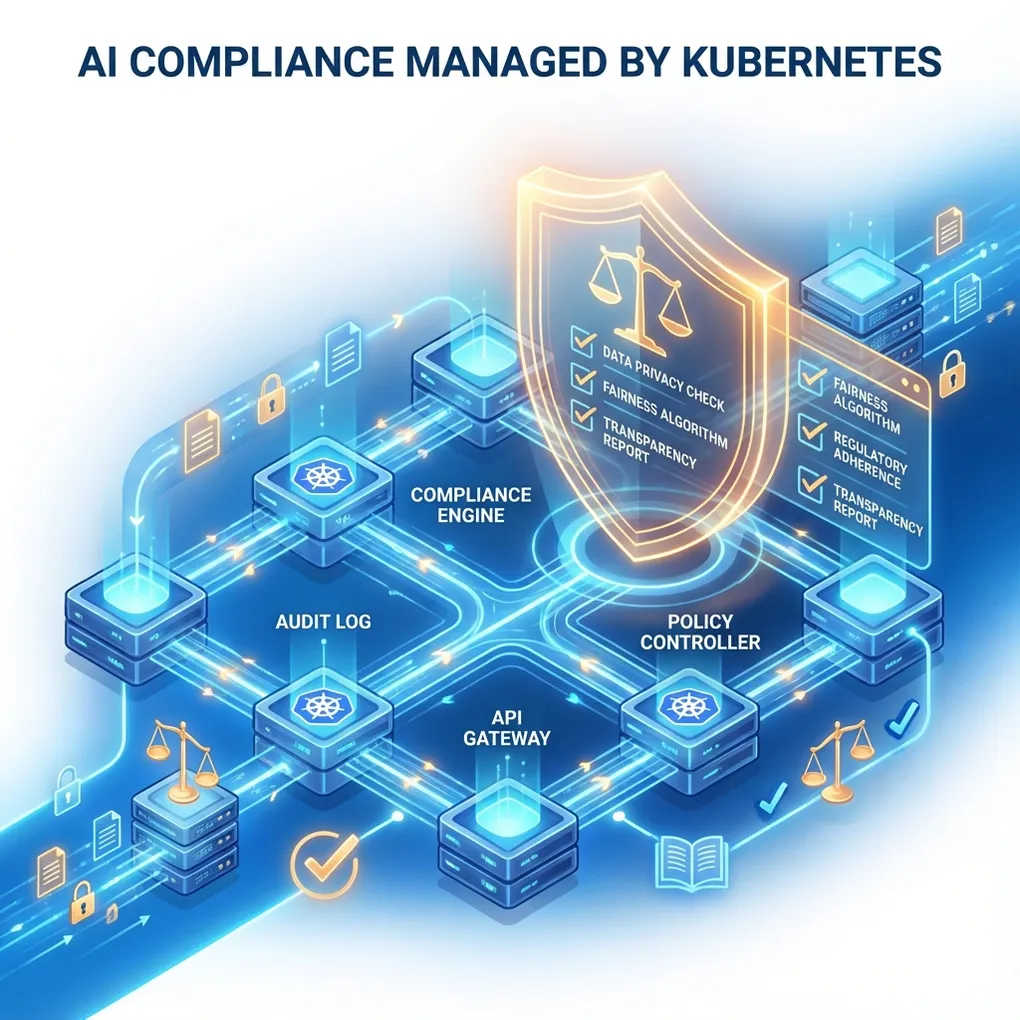
AI Compliance in the New Era: How Kubernetes Saves SMEs from Regulatory Hell
The era of “move fast and break things” in AI is officially over. With the EU AI Act fully enforceable and ISO 42001 becoming the gold standard, Small and Medium Enterprises (SMEs) are facing a new nightmare: Compliance.
For a Google or Microsoft, hiring a team of 50 compliance officers is a rounding error. For an agile SME, it’s an existential threat. How can you innovate rapidly while keeping track of bias audits, model lineage, and data governance standards?
The answer lies in the infrastructure you’re already building. Kubernetes (K8s) isn’t just a container orchestrator; it’s a standardized API for compliance.
The Standard API Gap
Most compliance frameworks fail because they are “document-based,” not “code-based.” You write a PDF policy saying “We check for bias,” but does your infrastructure enforcing it?
SMEs struggle because they lack a Source of Truth. Their models are in S3, their code is in GitHub, their logs are in Datadog, and their audits are in Excel. It’s a mess.
Kubernetes as the Source of Truth
By leveraging Kubernetes Custom Resource Definitions (CRDs), we can define “Compliant AI” as a standard API object. Imagine applying a policy like this to your cluster:
apiVersion: compliance.openvn.com/v1
kind: GoverningPolicy
metadata:
  name: eu-ai-act-high-risk
spec:
  requirements:
    - enforce-bias-check: true
    - data-sovereignty: "EU-West"
    - audit-logging: "strict"
Once this resource exists, the cluster itself becomes the enforcer.
1. Policy-as-Code with OPA/Kyverno
Tools like Open Policy Agent (OPA) or Kyverno act as the gatekeepers.
- Developer tries to deploy a model container.
- K8s Admission Controller checks: “Does this model have a link to a bias report?”
- If NO -> Deployment Rejected.
This transforms compliance from a “lagging indicator” (we check it once a year) to a “leading indicator” (it literally cannot run if it’s not compliant).
2. Immutable Audit Trails
In a K8s-native environment, every action is an API call. By piping Kubernetes Audit Logs into a tamper-proof storage, you automatically generate the “evidence” your auditors need.
- Who deployed model v2.1?
- When was the data processed?
- Which config map was used?
The audit trail is free. You don’t need to manually create it; you just need to collect it.
Automating the boring stuff
For SMEs, the goal is to automate adherence.
- Use Tekton or Argo Workflows to make “Compliance Checks” a mandatory step in your CI/CD pipeline.
- Use Crossplane to provision standardized, compliant cloud resources.
Conclusion
The new era of AI isn’t just about intelligence; it’s about traceability. By adopting Kubernetes as your compliance layer, you turn a bureaucratic burden into a competitive advantage. You can tell your enterprise clients: “We don’t just follow the standard; our infrastructure enforces it.”
Struggling with AI regulation? Let’s talk about how K8s CRDs can be your new compliance officer.